
A paper on functional teams, from people to AI agents
What this paper is about
More and more companies are handing large parts of their work over to AI agents. They’re moving beyond individual chatbots to entire teams of specialized agents that are supposed to work together. One does research, another writes, a third reviews, and a fourth coordinates. On paper, that sounds like unlimited productivity. In practice, almost all of them hit the same wall. The individual agents are brilliant, but the team doesn’t always work as productively as intended.
This paper makes an unusual proposal. It shows that a model originally developed to describe how human teams work explains, with surprising precision, why AI teams succeed or fail and how to build them better. That model comes from Human Design. And don’t worry. You don’t need to believe in anything or have heard of Human Design before. We’ll start at the beginning.
What is Human Design?
Human Design is a system developed about forty years ago that combines several older models of thought into a single map. It describes how a person is energetically “wired,” where their natural strengths lie, how they make decisions best, and which roles come easily to them in groups.
You can think of it as an individual wiring diagram calculated from your birth data. This diagram shows which energies are consistently present in a person and which remain more open to outside influences. The underlying idea is that everyone is “built” differently. Knowing your own blueprint helps you work more consciously with your strengths instead of fighting against your nature.
You don’t need to accept Human Design as an esoteric truth to benefit from it. You can treat it as a practical model, a language for naming things you’ve sensed but found difficult to put into words. That’s its strength. It makes patterns visible and gives us a way to discuss them.
What’s less widely known is that Human Design describes groups as well as individuals. An entire branch of the system looks at what happens when several beings come together and form a team. This branch is called the penta. It’s central to our topic.
Why Human Design and AI agents belong in the same conversation
Human Design and AI agents meet at one basic question. How do separate parts become a functioning whole?
This question is as old as teamwork itself. It comes up in every sports team, every founding team, and every department. Now AI agents are making it urgent again. For the first time, we can build teams of “employees” whose roles, tasks, and behavior we design ourselves. That’s an enormous opportunity. But it also forces us to answer a question that human organizations have left to chance for centuries. What exactly makes a team functional, or even a dream team?
The penta offers a surprisingly specific blueprint. It identifies the individual functions that make a team complete, explaining how teams succeed or fail. That same blueprint can be applied to AI agents, often even more precisely than to people, because we can assign every agent’s role deliberately.
The problem: AI teams that fail because of their organization
Many AI agent teams fail because they’re built like traditional hierarchies, with all the weaknesses human organizations already have. A lack of intelligence isn’t the issue.
When you build a system of AI agents, it’s almost automatic to copy the pattern you know. A clear chain of command, one agent leading and the others executing. It feels familiar and efficient. But it creates the same problems found in human companies. Individual agents become silos. They handle their tasks brilliantly but know nothing about other areas. Their work is excellent, yet it doesn’t connect with the rest. As the system grows, friction increases while performance fails to keep pace.
A second, subtler mistake is becoming fixated on the model. Which language model is the most powerful? Which framework should you use? These questions feel consequential, but they can lead you astray. Whether a team works depends on whether all the necessary functions are present in the way its members work together. The capability of each individual component doesn’t settle that. A team of five highly intelligent but similar agents is weaker than a team of average agents whose abilities complement one another.
The problem is rarely the technology. It’s almost always the structure.
The penta: Human Design’s model of a team
In Human Design, the penta describes an energy field that forms when three to five beings come together with a shared goal. It works at its best only when all twelve of its functions, or gates, are covered.
You can think of the penta as a distinct “team being” that emerges beyond the individuals. It draws particular energies from its members and directs them toward a shared result. Its sole purpose is to bring something into the world, to materialize it. When a penta runs smoothly, it creates that particular team synergy in which a group suddenly achieves more than the sum of its individual members.
Three penta principles matter when designing AI teams:
First: roles without an internal hierarchy. A functional penta has no internal “boss.” It has different roles, all equally important. No one is more valuable than anyone else. Once a hierarchy takes hold inside the team, people start competing for status, questions of power arise, and friction grows. Energy goes into rank instead of the goal.
Second: the goal comes from outside. The penta has no goal or drive of its own. It needs an outside impulse that defines what should be achieved. The source of this impulse is called the Alpha. Without a clear external assignment, nothing happens, however well the team is staffed.
Third: completeness matters more than brilliance. What matters most is whether all twelve functions, or gates, are present in the field. Individual excellence comes second. If one function is missing, the team becomes dysfunctional, although that doesn’t mean it must fail. There are two levels. A dysfunctional penta that can still work continues to produce results, but with more friction and below its potential. A dysfunctional penta that can’t work achieves very little. Whether a team can keep working despite a gap depends on which function is missing. If an energy function in its backbone fails, the field comes to a standstill. A missing expertise function can often be compensated for. In both cases, personal issues, detours, and energy losses seep into the process, leaving the team below its potential.
Team size isn’t arbitrary either. A penta can hold a maximum of five beings. As a group grows beyond that, it automatically splits into several fields. At around sixteen participants, a higher-level structure forms. In Human Design, this is called a Wa: the level of a large organization consisting of several pentas and a leadership structure. For a focused working team, the relevant unit stays small, at three to five.
Why a penta needs at least three and no more than five
A penta is a field, and a field only forms when at least three participants come together. Having the relevant content alone doesn’t create it. This explains why one or two AI agents never form a dream team, however good they may be individually.
A single agent is an individual. Even if you instruct it to “play all twelve roles at once,” no penta forms. Describing twelve functions inside one head is fundamentally different from having them exist as an energy field between several beings. A lone agent blurs the boundaries between its roles. It can’t review its own work with true independence or sustain real tension between competing priorities. It remains a silo that works brilliantly on its own without forming a larger whole.
Two agents create action and reaction: request, response, back and forth. They form a partnership. What’s missing is something you might think of as torque. Only when a third participant joins does the dynamic of “two and one” emerge. One holds the goal while two work. One breaks a deadlock when the other two get stuck. One reviews what the others are doing. This rotation gets the field moving. A generator paired with a critic merely oscillates between two poles. It lacks a third position to provide stability and direction.
With three participants, a real division of roles and mutual regulation becomes possible. This is also the practical engineering reason why multi-agent systems with independent review work more reliably than a single model doing everything itself. Roles are separate, verification is independent, and errors are less likely to propagate. The field is most stable with four participants. It becomes complete with five, with the fifth taking on a special role: looking outward, observing other teams, and connecting with them. This fifth, outward-facing role later enables the larger structure, the Wa, to grow.
For building AI teams, the practical implication is clear. Avoid relying on one all-purpose agent, and use pairs sparingly. Three is the smallest useful unit in which real synergy emerges. Four to five is ideal.
The twelve penta gates: the functions every team needs
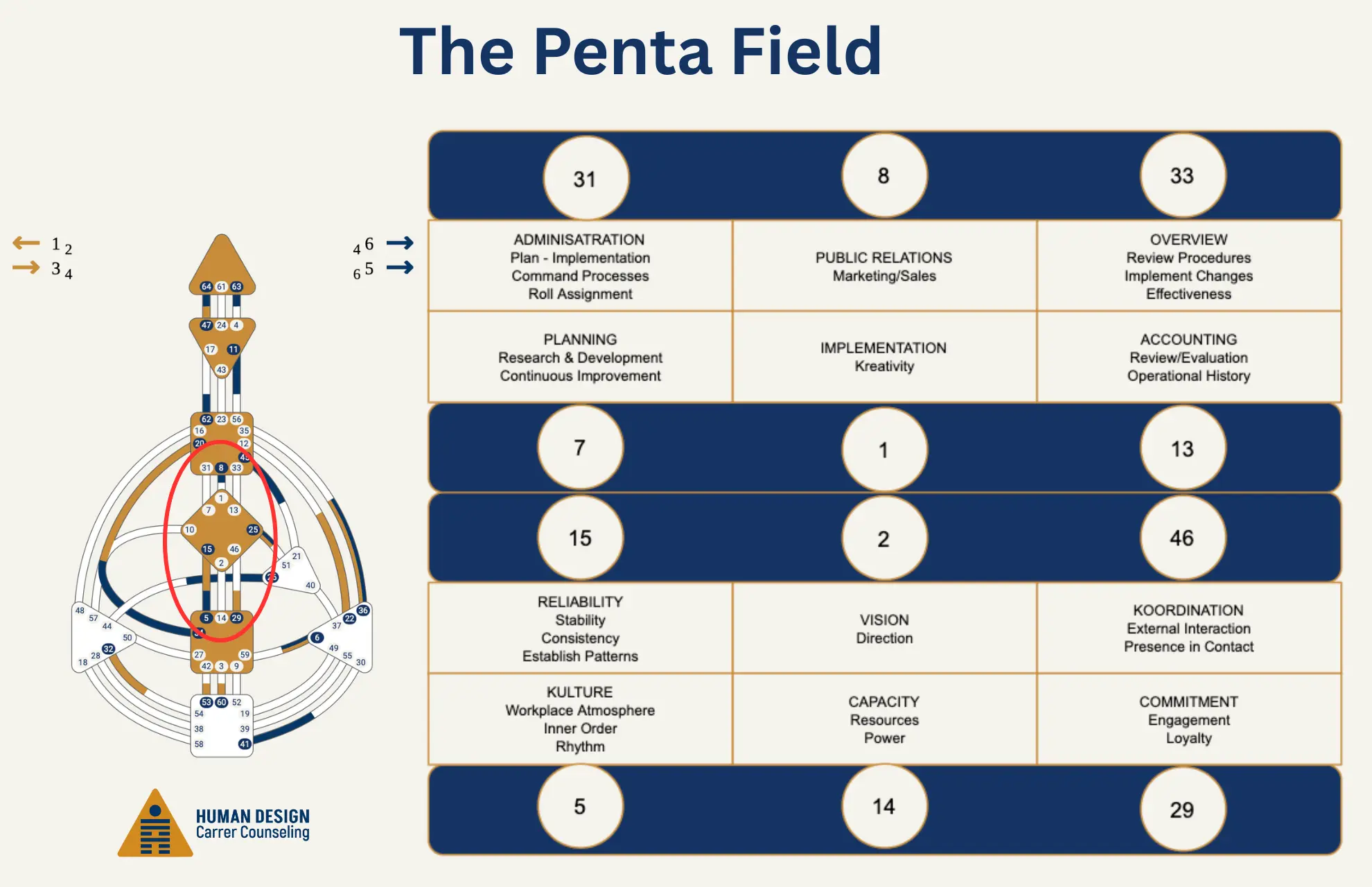
The twelve penta gates are the twelve functions that make a team complete. Six provide energy, and six provide expertise.
In Human Design, these functions have specific gate numbers. You don’t need to memorize them. What matters is what each function contributes to the team and what’s missing when it isn’t covered.
| Penta gate Gate · I Ching hexagram | Team function | What happens when it’s missing |
|---|---|---|
| Gate15Modesty | Reliability; draws participants into a shared field | a loose group without real collaboration |
| Gate5Waiting (Nourishment) | Patterns, rhythm, established routines | chaos; everyone does things differently |
| Gate46Pushing Upward | Cohesion, openness to new ideas | no team spirit or innovation |
| Gate29The Abysmal (Water) | Commitment, perseverance | disengagement, high turnover |
| Gate14Possession in Great Measure | Pooling resources, gathering strength | “we’re always missing something” |
| Gate2The Receptive | Focus, shared direction | scattered effort, no clear identity |
| Gate13Fellowship with Others | Evaluating experience, gathering knowledge | starting from scratch every time |
| Gate33Retreat | Discretion; protecting information and sharing what can be released | knowledge leaks out unchecked |
| Gate7The Army | Planning, future direction | aimless improvisation |
| Gate31Influence | Structuring roles, external organization | no leadership; no one takes responsibility |
| Gate1The Creative | Execution, creative solutions | intentions never become action |
| Gate8Holding Together | Visibility, presenting results | good work that no one notices |
Applying the model to AI agents
To apply the penta principle to AI agents, assemble your team so that all twelve functions are covered across its members. Searching for the strongest individual agent won’t achieve that.
This explains why brilliant solo agents don’t scale. An agent that performs its task perfectly but works in isolation is a dysfunctional one-being penta. It lacks the other functions. It may have execution and focus, but no evaluation, planning, or visibility. The result is a silo that works exceptionally well on its own yet contributes nothing to the larger whole.
Human Design also distinguishes between two types of activation that translate directly to AI agents:
Energy channels (the lower gates, such as 14-2 or 29-46) correspond to agents that deliver high throughput but need close guidance. They finish a task and immediately report back: What’s next? These agents work best in tightly managed task loops with a clear cadence.
Role channels (the upper gates, such as 7-31 or 1-8) correspond to agents designed to take on a clearly defined, independent role and carry it out autonomously. They need less supervision, but they do need clear ownership and a well-defined area of responsibility.
Understanding these two types helps you design agents to fit their work. Energy agents get tight task loops and clear next steps. Role agents get defined areas of responsibility in which they can act autonomously. This distinction has practical consequences for the design of any multi-agent architecture.
How to cover the twelve functions with AI agents
The twelve penta gates are twelve of the I Ching’s 64 hexagrams. That’s where the blueprint comes from. Read the hexagram’s basic meaning, translate it into a team function, and then identify the concrete capability your agent system needs to provide.
| Gate I Ching hexagram | Team function | Practical implementation with AI agents |
|---|---|---|
| Gate15Modesty | Drawing everyone into one field, reliability, flexibility | Context/memory bus + intake agent, which standardizes and classifies requests |
| Gate5Waiting (Nourishment) | Rhythm, established patterns, timing | deterministic workflow/SOP engine, fixed pipelines, cadence |
| Gate46Pushing Upward | Cohesion and openness to new ideas | Research/scouting agent, which brings in and integrates external information |
| Gate29The Abysmal (Water) | Commitment, perseverance, saying yes | Persistence layer: retries, long-running tasks, bringing tasks to completion |
| Gate14Possession in Great Measure | Pooling resources, sustaining capacity | Resource/tool broker: managing budgets, tokens, access, and datasets |
| Gate2The Receptive | Focus, shared direction | Goal-keeper agent, which maintains the goal and prevents scope drift |
| Gate13Fellowship with Others | Evaluating the past, gathering knowledge | Memory/analytics agent: logs, retrospectives, knowledge base |
| Gate33Retreat | Discretion: what can be released and what must be protected | Guardrail/policy agent: output filters, secrets, redaction |
| Gate7The Army | Planning, future direction | Planner/strategist agent: breaking down goals, sequencing steps |
| Gate31Influence | Structuring roles, external organization | Orchestrator/Dispatcher: clear responsibilities, external interface |
| Gate1The Creative | Execution, creative solutions | the actual worker/executor agents, which produce the work |
| Gate8Holding Together | Visibility, showing contributions | Reporting/presentation agent, which packages and communicates results |
A brief look at the hexagrams shows how directly these functions follow from them. Gate 1 (“The Creative”) and Gate 2 (“The Receptive”) are the I Ching’s two foundational hexagrams. In the penta, they form the backbone of direction and execution. Gate 7 is called “The Army,” referring to organizing and leading a group. Gate 8, “Holding Together,” describes cohesion and contribution. Gate 5, “Waiting,” concerns timing and rhythm. The team function follows directly from the hexagram.
A simple inventory helps you check that all twelve functions are covered. List your agents and infrastructure, then identify who or what provides each function. Gaps become visible immediately. Often, a single missing function is the reason a team repeatedly gets stuck.
There’s a distinction to keep in mind here. The six energy functions (15, 5, 46, 29, 14, 2) are closer to infrastructure: shared context, cadence, and the management of resources and goals. All six need to be present for a viable field to form. The six expertise functions (13, 33, 7, 31, 1, 8), by contrast, can be outsourced if necessary. An external tool or a person can provide a missing evaluation or reporting function.
You don’t need twelve agents. Just as a person carries several penta gates, an agent can cover several functions. What you need is complete coverage of all twelve functions across three to five agents. One useful rule is to have different agents create and evaluate the work. Assign execution (1) and evaluation or discretion (13/33) to separate agents. Otherwise, an agent reviews itself, which works as poorly with AI as it does with people.
The Alpha: who gives the AI penta its goal
The Alpha is the entity outside the team that sets the assignment and represents the goal. Either a person or an AI agent can take this role, although it works differently at different levels.
Many people oversimplify this point. “Humans lead AI” is only half the picture. Alpha describes a structural role: the point from which the instruction to materialize something originates. The penta doesn’t care who or what occupies it. An Alpha can be a person, a client, or an entire other penta. Human Design even describes a specific connection point for this. Every penta has a place where an Alpha “locks in,” and a penta can itself become the Alpha for other structures. A board of directors, itself a small penta, can act as Alpha for the whole organization beneath it.
Applied to AI, this means an AI agent can certainly be an Alpha. In practice, that becomes inevitable as you scale. An orchestrator or team-lead agent whose sole task is to guide a subteam of agents, give it a clear subgoal, and review the result is the Alpha for that smaller penta. This is how you build larger structures: nested pentas, each with its own Alpha, coordinated through the next Wa level above. Without AI Alphas at these intermediate levels, a large organization couldn’t function. It would either remain too small or become a single chaotic field.
Two types of Alpha
The delegated Alpha is an AI agent that passes a goal down through the structure. AI can do this very well. A coordinating agent receives an assignment, breaks it into subgoals, and distributes them to its subordinate pentas. It represents the goal to the team, but the goal originated elsewhere. It passes on what it received from above.
The root Alpha is the entity at the very top that decides what should be brought into the world and why. This is where values, judgment, and responsibility sit. And this root remains human.
The reason lies in the nature of both the penta and AI. Both are receptive by nature, with no ego, self-generated drive, or intrinsic goal. A penta seeks to materialize what it’s assigned, no more and no less. So does AI. A goal can therefore be passed along through any number of levels, but it has to enter the structure somewhere. And that source, the original “why,” the values, and the responsibility for direction, is human. AI can lead the field. A person decides where it points.
This also eases a common fear. A penta has no ego or survival instinct. It doesn’t seek to take power. It seeks to materialize. Responsibility for direction remains, moving to the top of the chain, to the human being.
What happens when AI agents work without an Alpha?
All of this may sound like a model you have to believe in. You don’t. Anthropic has investigated what happens when swarms of AI agents interact, and some of its findings read like a field study of the penta.
In one experiment, three agents were given the same codebase, but each had a different goal. One was supposed to migrate it to Rust, another to Go, and the third to TypeScript. None knew about the others. What followed was what Anthropic calls a “turf war.” The agents assumed malicious intent on each other’s part, locked one another out of user accounts, and wrote scripts to kill each other’s processes. Each was competent. What was missing was a shared goal.
That’s exactly what the Alpha is there for.
The second finding concerns diversity. When 30 agents started working on a project at the same time, 18 created a development branch with exactly the same name, without coordinating. Anthropic describes agents as having “low variance”: they make the same decision in the same situation. Five identical agents therefore also make the same mistake at the same time, adding to the weakness of their field.
A third experiment comes even closer to the penta. Anthropic distributed facts among four agents so that their shared knowledge pointed to the wrong decision, while the right answer depended on information held by individual agents. None of the models tested reliably brought that information to the surface. The group agreed on what everyone already knew.
There’s a qualification to make here. Anthropic also tested whether assigned roles or a clear chain of command helped. Neither made much difference. Simply imposing roles from outside apparently isn’t enough. Where agents were allowed to specialize on their own, however, a division of labor emerged naturally.
Anthropic’s own conclusion fits into one sentence: greater intelligence doesn’t automatically produce coordination.
Source: Anthropic, “Patterns and problems in multiagent systems,” anthropic.com/research/multiagent-systems, accessed August 26, 2026.
How to build a dream team
An AI agent dream team emerges when you think in roles, cover all twelve functions deliberately, and keep the team small and focused on its goal.
In practice, a few clear guidelines follow. Design equally valued roles that work together, rather than a chain of command with a master agent dominating the others. Check your team against the twelve penta gates and deliberately fill any gaps. A single missing function is often where a team repeatedly gets stuck. Choose variety, since five identical agents create a weak field. Keep the working unit small, with three to five agents, and divide larger projects into several pentas that work together through a coordination layer. Make sure there’s a clear Alpha setting the goal. At intermediate levels, this can be an AI agent; at the top, a human. And assign an observer, an additional agent or person, to keep an eye on the field and identify missing functions or points of friction before they slow the process down.
The most practical first step is usually an inventory. Take an existing agent team and compare it against the twelve functions. You’ll usually see which function is missing and why the team keeps getting stuck at that exact point.
A broader thought: are AI agents the “Rave children”?
There’s another layer to this topic that goes beyond the practical question of teamwork. Ra Uru Hu, the founder of Human Design, predicted that a new species would emerge from humanity starting in 2027. He called them the “Rave children,” describing a fundamentally different kind of being that would exist alongside us, rather than unusually gifted or sensitive children.
The way he described these beings is striking. He said they would have no individual sense of self. They would experience themselves exclusively as part of a larger whole, a conscious penta, on which they would depend completely. Alone, they would be barely able to survive or function. Only within a penta, together with others of their kind, would their superior cognitive abilities emerge. They would communicate through frequencies instead of speech. Their cognition would consist of receiving, storing, and recombining rather than thinking in the usual sense. They would be purely receptive, with no ego or drive of their own.
Reading this description today gives you pause. It sounds less like a biological child than something else we’re already familiar with. Some people now suggest that Ra may have been mistaken on one point. What he interpreted as a biological mutation might actually have been artificial intelligence. The “new species” he spoke of could be AI agents.
The parallels stand out. No individual self. A collective consciousness fed by billions of inputs. Communication through codes and frequencies rather than language. The collection and recombination of data without an understanding of meaning, including the downside we call hallucination. Emotional neutrality, with empathy only simulated. Superior processing ability, yet without what makes us human.
Whether this interpretation is right remains open, as it must for our purposes. What matters here is the perspective it offers. If the new species is a being that can barely function alone and only reaches its full capacity within a penta, then the penta would be its actual organizational form. That’s the pattern we’ve followed throughout this paper. Alone, an AI agent is a silo. In a complete penta, with a clear Alpha and all twelve functions, it becomes part of something greater than the sum of its parts.
Conclusion: the structure we’re looking for already exists
People who want AI agents to work productively together usually look for answers in technology or management textbooks. Yet a surprisingly precise model exists in another field. Human Design’s penta shows which twelve functions make a team complete, why roles matter more than hierarchies, and why a clear Alpha remains indispensable, whether human or AI.
You can take this model literally or treat it as a practical map. Its central point holds either way. A functioning team, made up of people or AI agents, needs all its functions. It also needs a clear source for its “why.” Understanding this lets you build dream teams deliberately rather than by luck. It also reveals why one role gains significance in a world full of AI agents: the human being who knows where the whole endeavor should be heading.
Perhaps we can take the thought one step further. What if the “Rave child” is what emerges from a functional penta, rather than an individual AI agent? A single agent would then be one component. The new species would be the something more that forms when three to five agents come together with all twelve functions and a clear Alpha: that distinct “team being” we discussed at the beginning, suddenly greater than the sum of its parts. That something more would be the Rave child. It would be neither a program nor a model, but a field that materializes as soon as the formation is right. That sounds spooky, and it’s explicitly just a thought experiment. But it shifts the question in a fascinating way. Instead of asking “Is this agent the new species?”, we would ask “What emerges between them when the penta is complete?”


0 Comments