You probably know the feeling. Everyone on the team works hard, everyone means well. And it still grinds. Goals get reached late and with effort, there are too many meetings, and somehow nobody is pulling in the same direction. Usually we then start looking for the fault in individual people. Human Design invites you to look at the energy instead.
What does Human Design mean in a team context?
Human Design in a team means using the different energy types of a group deliberately instead of working against them. Every person has an energetic build: Generator, Manifesting Generator, Projector, Manifestor or Reflector. That build determines how someone builds up power, makes decisions and feels most at ease in a group.
A team doesn’t work better when everyone ticks the same way. It works better when every energy sits in the right place. A Projector who’s expected to grind away like a Generator burns out. A Generator who’s constantly asked to lead without being allowed to execute gets frustrated. Human Design makes these patterns visible before they turn into conflicts.
How to recognize a dysfunctional team
A team turns dysfunctional the moment its members put energy into things that no longer have anything to do with the actual task. Instead of working, people administrate, maneuver and cover themselves.
The typical warning signs are surprisingly concrete:
- weak productivity, even though everyone looks busy
- goals are reached late and only with great effort
- recurring conflicts that never resolve
- wasted energy, a lot of input for little result
- communication problems and misunderstandings
- high turnover
- too many meetings that move nothing
From a Human Design point of view, none of that is coincidence. When people work against their energy over the long run, exactly this loss through friction is what you get. The frustrated Generator who isn’t allowed to respond to the right thing. The bitter Projector whose advice nobody asks for. The angry Manifestor who keeps getting slowed down. Dysfunction is often just the sum of many people in the wrong energetic mode.
What sets functional teams apart
You recognize a functional team by the fact that energy flows instead of backing up. People like working together, they trust each other, and they know what’s expected of them.
The marks of healthy teams read almost like a description of people working in tune with their design:
- enjoyment at work and satisfaction in the collaboration
- mutual trust, and trust in the team as a whole
- everyone knows what’s expected
- conflicts get resolved informally and calmly
- discussion is open, everyone contributes equally
- everyone respects the team process and the others
- everyone counts the same
- the team arrives at decisions
- criticism is constructive
A healthy team isn’t a team without differences. It’s a team where the differences finally make sense.
Human Design gives you the language for that. Once you understand that one person has to respond before they get going, and another wants to be invited first, difference stops being an irritation. It becomes a resource.
The energy logic of the five types
Each of the five types brings its own basic function into the team. Once you know that logic, you hand out tasks by energy instead of by hierarchy.
| Typ | Role in the Team | strenght | If used incorrectly |
|---|---|---|---|
| 01Generator | The doer | Stamina, real workhorse when he’s on form | Frustration, giving up mentally |
| 02Manifesting Generator | The all-rounder | Speed, versatility, multiple tracks at the same time | Impatience, frantic chaos |
| 03Projector | The rider | Overview, insight into human nature, efficiency | Bitterness, exhaustion |
| 04Manifestor | The Initiator | Raise a glass, get something new off the ground | Resistance, going it alone |
| 05Reflector | The mirror | An instinct for team wellbeing | A sense of disorientation, withdrawal |
How do the types really work together?
The types work well together when everyone is allowed to follow their nature. And badly the moment they get squeezed into roles that aren’t theirs. The most common friction points are remarkably predictable.
The unseen Projector on a Generator team is a classic. Generators are the energetic majority, they get things done. The Projector brings the overview, but only if you ask and then listen. If they get overlooked, their valuable view goes quiet, and the team loses its natural navigator.
The Manifestor who doesn’t inform is the second classic. Manifestors set things in motion, often on their own. If they don’t inform the people around them, the team feels run over and starts working against them without meaning to. For Manifestors, informing isn’t politeness. It’s the lubricant of collaboration.
And then there are the Generators and Manifesting Generators themselves. They need something to respond to. If all they get is abstract instructions instead of concrete questions and tasks, their enormous power fizzles out. A team that doesn’t “ignite” its Generators properly leaves its strongest engine running cold.
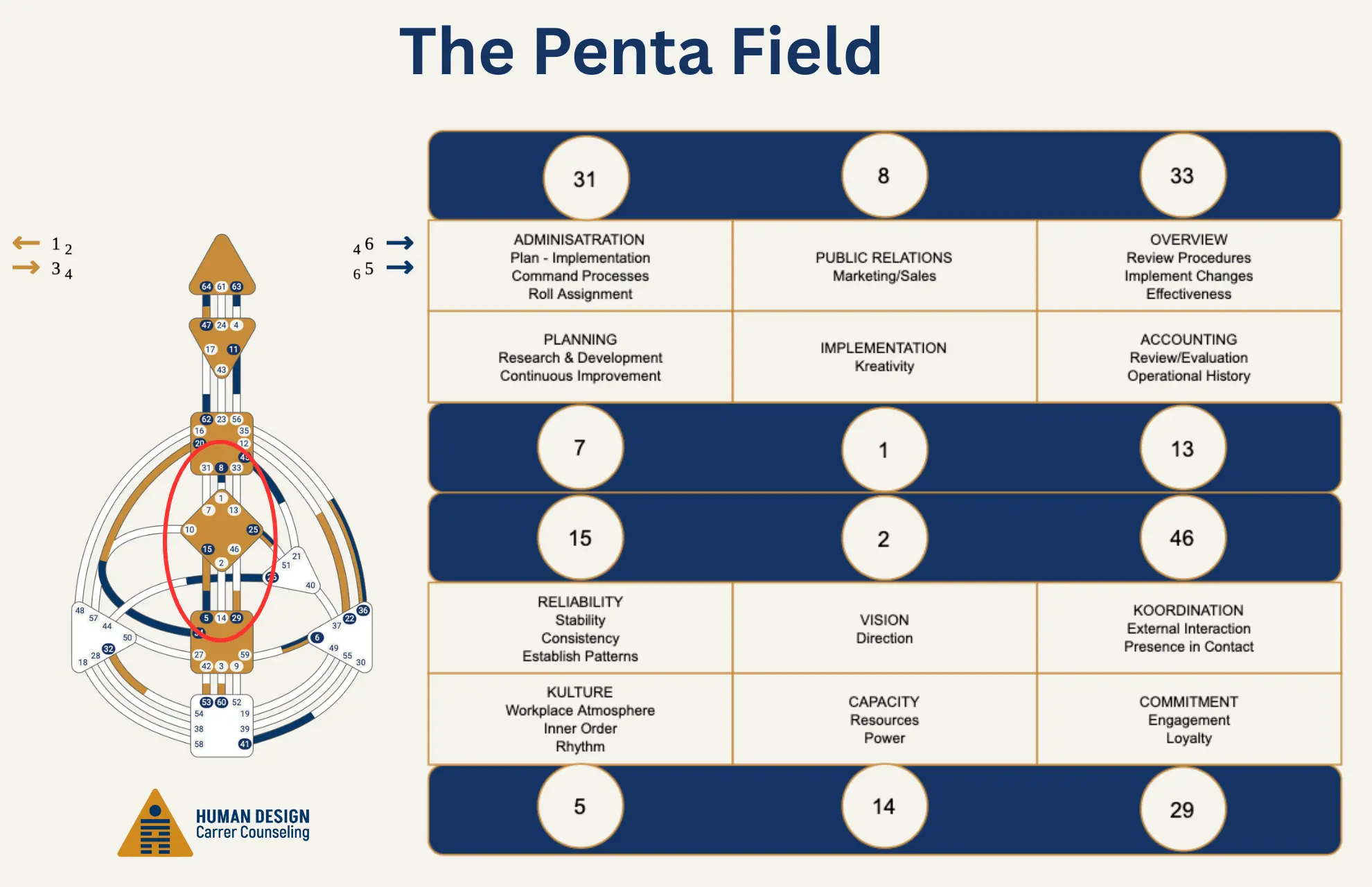
The penta: the invisible force field of your team
As soon as three to five people work together, Human Design says a group force field of its own comes into being: the penta. It’s a transpersonal field of twelve frequencies that forms out of the energies of everyone involved. And it shapes the people inside it just as much as they shape it. Alongside the individual type, the penta is the second big effect that decides whether a team succeeds or fails.
The most important sentence first: inside the penta we leave our individuality behind and fit ourselves into the small group. The penta belongs to nobody alone. It has a power structure of its own that can differ from the individual charts. Someone who is no leadership figure in their personal design can suddenly carry the leading role in the penta, and the other way around. That’s exactly why individual analyses alone never explain a whole team.
You can read about how the five types in the Human Design Team work together effectively in a separate article on the subject. And how AI agents fit into the Penta is also an interesting thought experiment.
Why the penta is so powerful
The penta is a “materialization” force field. It works along the pattern of energy, direction, expression and action, and it actually brings things down to the ground. Inside the penta it’s about productive functionality. It “pulls” the matching frequencies out of the people. Everyone contributes a part, and out of that connection something new emerges that’s bigger than the sum of its members. That’s why small, well-staffed teams are often so much more effective than large gatherings.
The two levels: boiler and expertise
The penta has an upper and a lower level, and they depend on each other.
The lower level is the driver, the “boiler.” This is where the raw working power sits (the sacral center). It delivers the energy, but it needs guidance and clear steering, almost in the sense of healthy micromanagement.
The upper level reflects expertise. The know-how, the expression, the visibility (the throat). It knows what should be done, but it has no drive of its own. It needs the power from below.
A team that works lives on the interplay of both levels. Expertise up top gives the direction, the boiler down below delivers the power to execute. If either one is missing, the penta runs hot or comes to a standstill.
The twelve frequencies of the penta
The penta consists of six functional areas (in the chart these are six channels around the throat, the G center and the sacral). Each area has an upper frequency (expertise) and a lower one (drive). Together they make up the twelve tasks that make a team genuinely able to work:
| Functional area | Upper level: Expertise | Lower level: Drive (boiler) |
|---|---|---|
| 01Leadership & Roles: The Penta has a future | Administration: Assigning roles, impact, the gateway to leadership | Planning: Research & Development, strategy, the direction of the future |
| 02Contribution & Public Image: Penta can | Public Relations, Marketing/Sales, present the contribution | Implementation: Creativity, originality, putting ideas into practice |
| 03Overview & MemoryThe Penta is protected | OverviewReviewing processes, safeguarding knowledge | Taking stockLooking back, evaluating the past |
| 04Stability & RhythmThe Penta is vibrant | ReliabilityConsistency, establishing patterns, flexibility | CultureWorking atmosphere, internal order, rhythm |
| 05Alignment & Resources: The Penta seeks | Vision, Direction, Orientation | Capacity, Resources, Strength |
| 06Connection & BondingThe Penta is ready | CoordinationExternal contact, presence | CommitmentLoyalty, commitment, getting involved |
Missing frequencies are the real weak points
For a specific team, you can check which of the twelve frequencies its members cover and which are missing. A gap in the penta often explains patterns that have been running for years. If the frequency “culture” is missing, the working atmosphere is never quite right. If “vision” is missing, the team circles busily without direction. If “commitment” is missing, people jump ship as soon as things get uncomfortable.
Why team size matters energetically
A penta forms out of three to five people, and five is the complete, ideal size. If a sixth person joins, two separate penta force fields form immediately. From around sixteen people on, a different group dynamic takes over, the so-called wa (simplified: three pentas of five people each, plus a leading alpha role).
Not every team size works the same way energetically. When a team of five grows to six, the field splits, and suddenly there are subgroups, camps and friction without anyone having done anything “wrong.” If you know that, you build teams more deliberately: closed units of up to five people, or a clear structure of several pentas with defined leadership.
The Reflector as a seismograph for team health
The Reflector is the rarest type and the most honest gauge in a team. They carry no fixed energy of their own, they mirror their surroundings. That’s why how they’re doing tells you the state of the whole team.
If the Reflector is doing well in a team, that’s a strong sign of a healthy culture. If they withdraw, seem exhausted or disoriented, then something in the field is off. Even if nobody else feels it yet. Smart leaders make use of this. They deliberately ask the Reflector how the collaboration feels from where they sit. That answer is often the most honest team diagnosis you can get.
Human Design for leaders: what it looks like in practice
Human Design for leaders mostly means handing out tasks, meetings and appreciation by energy instead of with a watering can. A few concrete approaches:
- Handing out tasks: give Generators and Manifesting Generators concrete things they can respond to. Ask Projectors for overview and strategy. Let Manifestors initiate what’s new, and ask them to inform the team.
- Designing meetings: not everyone has to be in every meeting. Too many meetings are a classic sign of dysfunction. Keep the energetically relevant group small, ideally a penta of up to five people.
- Showing appreciation: the Projector needs recognition for their view, not for their hours. The Generator wants to feel that their work moves something. Appreciation only lands when it matches the energy.
- Putting teams together: watch the size. Five well-matched people often move more than ten who split into two force fields.
Leadership in Human Design is less about control and more about making things possible. You don’t have to change anyone. You only have to find the right place.
Your team has an energy, use it
A team is more than a collection of people. It’s a force field of its own with its own dynamic. Once you know the energy types of your people and understand the penta of your team, you stop working against invisible resistance. A diversity of energies then stops being a disruption and becomes your greatest strength.
Would you like to know which energy you bring into a team yourself, and where your natural place is? In a written Human Design career analysis you get insight into yourself in the “career” area of your life and into your role in collaboration, so that you have your effect where your energy carries the furthest.
FAQ: questions and answers about Human Design in teams
What is a Human Design team?
A team that works deliberately with the energy types of its members: Generator, Manifesting Generator, Projector, Manifestor and Reflector. Instead of treating everyone the same, each energy is put to work where it’s strongest.
Which Human Design type is suited to leadership?
Leadership isn’t a question of type, it’s a question of role. Projectors often lead through overview and a feel for people, Manifestors through initiative. But Generators and Reflectors can lead too, each in their own way.
How many people fit into a team ideally?<br />
From a penta point of view, three to five people is the energetically soundest size. From the sixth person on, the force field splits. From around sixteen, a different group dynamic with several pentas takes over.
What is the penta in Human Design?
The penta is a transpersonal group force field of twelve frequencies that comes into being as soon as three to five people work together. It has two levels, expertise up top (what gets done) and the drive, the “boiler,” down below (the working power), and it turns teams into units that can actually act.
How do I know that a penta function is missing in my team?
By stubborn patterns: no real atmosphere despite nice people (missing culture), plenty of activity without direction (missing vision), or people jumping ship (missing commitment). A penta analysis shows which of the twelve frequencies your team covers and which it doesn’t.
Can Human Design resolve conflicts in a team?
Human Design doesn’t resolve conflicts automatically, but it makes their cause visible. What often shows up is this: it’s not that the people don’t fit together, it’s that their energies are sitting in the wrong place.


0 Comments